SBE CHAPTER 24 NEWSLETTER
March 1, 2003
By Vicki W. Kipp
The day that the WHAD/Delafield tower at the Lapham Peak Unit of Kettle Moraine State Forest would be dismantled dawned sunny and bitter cold. Only the lack of wind and falling snow on Monday morning, March 3, made outdoor work tolerable. As the morning progressed, the sky clouded up and snowflakes would soon fall.
WHAD-FM 90.7, a Wisconsin Public Radio (WPR) member station, broadcasts “The Ideas Network” to the Milwaukee area.
WHAD Chief Engineer John Frank recounted the site’s history. The old WHAD tower (Figure 1) had stood strong since 1962. It was actually a combination of two separate towers that were grafted together at the 340-foot level.
Decades ago, a broadcast engineer named Jack Steele built the Wisconsin Public Radio network with World War II surplus materials. Reportedly, Jack Steele got a bargain on some used tower sections. A Madison TV station had left their disassembled old tower sections lying in the mud after building a new taller tower. Those sections had a second life as the WHAD tower.
Prior to the 1962 tower, WHAD-FM used an older tower that dated back to around 1948. In these days of difficult zoning and expensive tower construction, it might seem surprising that a standing tower would be intentionally brought down.
When WHAD-FM learned that they had to relocate their tower site, it was determined that the 1962 combination tower needed to be replaced. The old WHAD tower did not meet the TIA/EIA RS-222F standard currently in effect.
The steel structure would be collapsed and cut up for scrap metal. Bringing down a tower located in a state park required the coordination of several different groups including the power company, the DNR, the tower company, a construction company, and WHAD’s licensee, the Educational Communications Board (ECB). The ECB’s involvement in this project was coordinated by ECB Technical Services Manager Peter Ives.
A new tower site was constructed for WHAD on nearby Department of Corrections land. WHAD had been broadcasting from their new location for a few months before the old site was dismantled.
Most of the antennas and hardware had been removed from the old WHAD tower, but part of the old WHAD antenna, a weather antenna, a couple two-way antennas, and one microwave dish remained on the tower. The cost of removing the antennas was greater than their actual value.
The falling object danger zone around the tower was cordoned off with yellow tape warning, “Caution Hard Hat Area.” Ford Construction Co, Inc of Waukesha had already dismantled the WHAD transmitter building and concrete base. They were ready to remove the concrete tower foundation and guy anchors as soon as the tower was collapsed.
DNR Ranger Edward Muzik and his colleagues temporarily closed the Lapham Peak Unit by locking the front gate. DNR staff was positioned around the base of the tower to ensure that hikers entering from neighboring subdivisions didn’t go into the danger zone. Technicians from WE Energies killed the power lines, causing a localized power outage for the DNR’s Lapham Peak facilities. The power technicians awaited the tower fall anxiously.
If the tower fell as planned, it would miss nearby power lines and wooden poles. If not, WE Energies would have to repair or replace damaged poles and lines.
Blackhawk Tower Communications, Inc. of Deerfield, Wisconsin was hired to take down the old WHAD tower. In business since 1996, Blackhawk Tower (Figure 2) is owned by John Stoller, IV and is a member of the National Association of Tower Erectors (NATE.)
A tower technician from Blackhawk Tower climbed to the mid-height of the tower, where he removed the bolts from the flange on the opposite side of where the tower was intended to collapse. The tower technician quickly repelled down the tower after removing the flange bolts.
Then, a ground crew used a gasoline powered chop saw to cut off the turnbuckle bolts for the guy wire supporting the side of the tower where the flange bolts had been removed.
The fall occurred quickly, quietly, and efficiently. The tower did not hit any power lines or poles during its drop.
ECB engineer Phil Mikalofsky observed, “I expected that the descent of the tower would have been louder than it actually was.”
After the turnbuckle bolts were cut off, the tower began to lean toward the west (Figure 3). The guy wires on the east were hanging slack. Bolts could be heard popping off the tower followed by a brief ”creaking” sound. Then, the tower bent where the flange had been unbolted for lack of support (Figure 4).
With the tower bent in half, the top section hit the ground. The tower sections compressed on themselves (Figure 5), and the collapsed tower came to rest with sections strewn horizontally.
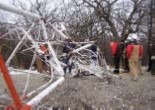
There were no cries of “Timber!” as the tower fell, but once it landed the crowd let out cheers and applause. We walked several hundred yards to the fall site to take in the debris (Figures 6, 7, and 8).
Once-taut guy wires curled into metal ringlets (Figure 9). A microwave dish groaned as it compacted on itself (Figure 10). Decades-old steel had been transformed from a precise straight structure to contorted metal segments.
Normally, a fallen tower would be a sorrowful sight, but in this case, it marked a tower that had dropped successfully according to plan. The tower crew began removing steel and cleaning the site, and I headed for the warmth.

Figure 1. The final moments for the Lapham Peak WHAD tower.

Figure 2. Blackhawk Tower Communications, Inc. displays a warning sign.

Figure 3. After the guy wire was cut, the tower began to lean toward the West.

Figure 4. The tower bent in half and the top hit the ground.

Figure 5. Tower sections compressed on themselves.

Figure 6. Surveying the situation.

Figure 7. A 45-foot Lapham Peak observation tower is spared during the WHAD collapse.

Figure 8. Workers observe the twisted steel.

Figure 9. Untensioned guy wire curls into spirals.

Figure 10. Microwave dish crushing inward. for lack of support.

Leave a Reply